Competency E1: Apply quantitative reasoning and appropriate mathematics to describe or explain phenomena in the natural world.
Learning Objectives:
- Demonstrate quantitative numeracy and facility with the language of mathematics.
- Interpret data sets and communicate those interpretations using visual and other appropriate tools.
- Make statistical inferences from data sets.
- Extract relevant information from large data sets.
- Make inferences about natural phenomena using mathematical models.
- Apply algorithmic approaches and principles of logic (including the distinction between cause/effect and association) to problem solving.
- Quantify and interpret changes in dynamical systems.
Competency E2: Demonstrate understanding of the process of scientific inquiry, and explain how scientific knowledge is discovered and validated.
Learning Objectives:
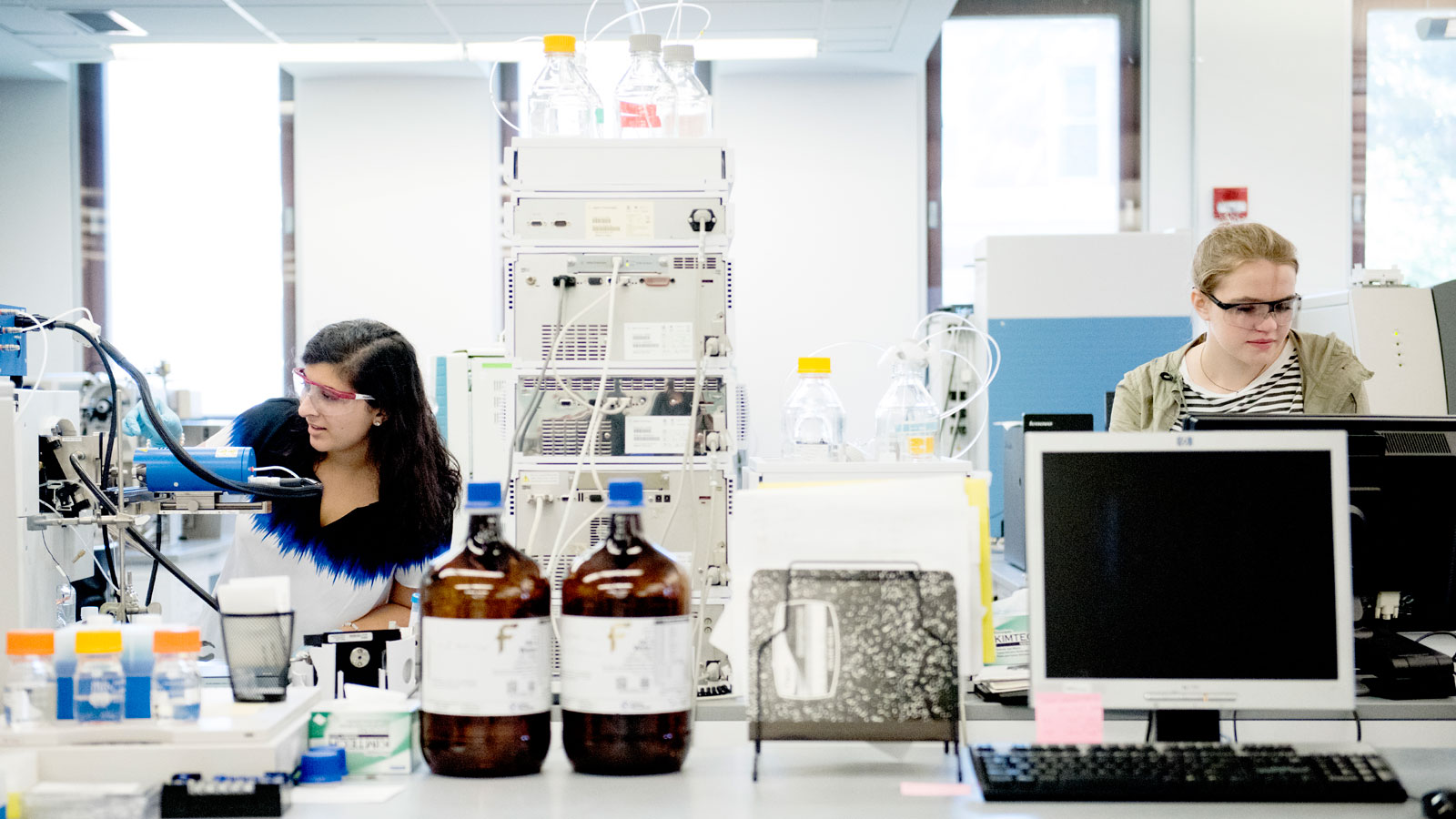
- Develop observational and interpretive skills through hands-on laboratory or field experiences.
- Demonstrate ability to measure with precision, accuracy, and safety.
- Be able to operate basic laboratory instrumentation for scientific measurement.
- Be able to articulate (in guided inquiry or in project-based research) scientific questions and hypotheses, design experiments, acquire data, perform data analysis, and present results.
- Demonstrate the ability to search effectively, to evaluate critically, and to communicate and analyze the scientific literature.
Competency E3: Demonstrate knowledge of basic physical principles and their applications to the understanding of living systems.
Learning Objectives:
- Demonstrate understanding of mechanics as applied to human and diagnostic systems.
- Demonstrate knowledge of the principles of electricity and magnetism (e.g., charge, current flow, resistance, capacitance, electrical potential, and magnetic fields).
- Demonstrate knowledge of wave generation and propagation to the production and transmission of radiation.
- Demonstrate knowledge of the principles of thermodynamics and fluid motion.
- Demonstrate knowledge of principles of quantum mechanics, such as atomic and molecular energy levels, spin, and ionizing radiation.
- Demonstrate knowledge of principles of systems behavior, including input–output relationships and positive and negative feedback.
Competency E4: Demonstrate knowledge of basic principles of chemistry and some of their applications to the understanding of living systems.
Learning Objectives:
- Demonstrate knowledge of atomic structure.
- Demonstrate knowledge of molecular structure.
- Demonstrate knowledge of molecular interactions.
- Demonstrate knowledge of thermodynamic criteria for spontaneity of physical processes and chemical reactions and the relationship of thermodynamics to chemical equilibrium.
- Demonstrate knowledge of principles of chemical reactivity to explain chemical kinetics and derive possible reaction mechanisms.
- Demonstrate knowledge of the chemistry of carbon-containing com- pounds relevant to their behavior in an aqueous environment.
Competency E5: Demonstrate knowledge of how biomolecules contribute to the structure and function of cells.
Learning Objectives:
- Demonstrate knowledge of the structure, biosynthesis, and degradation of biological macromolecules.
- Demonstrate knowledge of the principles of chemical thermodynamics and kinetics that drive biological processes in the context of space (i.e., compartmentation) and time: enzyme-catalyzed reactions and metabolic pathways, regulation, integration, and the chemical logic of sequential reaction steps.
- Demonstrate knowledge of the biochemical processes that carry out transfer of biological information from DNA, and how these processes are regulated.
- Demonstrate knowledge of the principles of genetics and epigenetics to explain heritable traits in a variety of organisms.
Competency E6: Apply understanding of principles of how molecular and cell assemblies, organs, and organisms develop structure and carry out function.
Learning Objectives:
- Employ knowledge of the general components of prokaryotic and eukaryotic cells, such as molecular, microscopic, macroscopic, and three-dimensional structure, to explain how different components contribute to cellular and organismal function.
- Demonstrate knowledge of how cell–cell junctions and the extracellular matrix interact to form tissues with specialized function.
- Demonstrate knowledge of the mechanisms governing cell division and development of embryos.
- Demonstrate knowledge of the principles of biomechanics and explain structural and functional properties of tissues and organisms.
Competency E7: Explain how organisms sense and control their internal environment and how they respond to external change.
Learning Objectives:
- Explain maintenance of homeostasis in living organisms by using principles of mass transport, heat transfer, energy balance, and feedback and control systems.
- Explain physical and chemical mechanisms used for transduction and information processing in the sensing and integration of internal and environmental signals.
- Explain how living organisms use internal and external defense and avoidance mechanisms to protect themselves from threats, spanning the spectrum from behavioral to structural and immunologic responses.
Competency E8: Demonstrate an understanding of how the organizing principle of evolution by natural selection explains the diversity of life on earth.
Learning Objectives:
- Explain how genomic variability and mutation contribute to the success of populations.
- Explain how evolutionary mechanisms contribute to change in gene frequencies in populations and to reproductive isolation.