Why Physics or Biomedical Physics at Northeastern?
The NEU Physics Department offers a broad range of curricula that reflect the intellectual excitement and relevance of studying physics both within its broadly defined traditional boundaries and at the intersection with other disciplines, in particular the biomedical sciences, where physics is having a growing impact. In addition, the department offers unique opportunities for students to experience frontline research at the undergraduate level through internships in faculty research labs and coops.
As a Physics major, a student explores the fundamental physical principles that govern natural phenomena ranging in scale from collisions of subatomic particles, to atoms and molecules, to various condensed phases such as solids and liquids, to exploding stars and colliding galaxies.
As a Biomedical Physics major, a student explores fundamental physical principles relevant for understanding biological phenomena on various scales as well as medical instrumentation and devices. This program takes advantage of the local Boston area medical research environment to offer a unique interdisciplinary learning experience and also offers the option of a premed track.
Other Interdisciplinary Curricula
The Physics Department also offers an undergraduate BS Applied (interdisciplinary) Physics program, a combined undergraduate/graduate level Applied Physics and Engineering BS/MS program, and several undergraduate combined majors in collaboration with other departments. The list of current combined majors includes Physics and Chemical Engineering, Physics and Computer Science, Physics and Electrical Engineering, Physics and Environmental Geology, Physics and Mathematics, and Physics and Philosophy.
Experience Frontline Research, Small Class Size
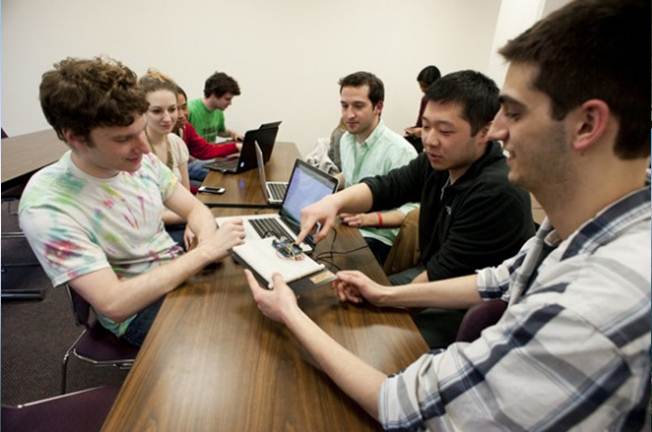
Our undergraduate students benefit from small class sizes and have ample opportunity to interact with faculty doing cutting edge research in diverse fields related to their coursework. The advanced laboratory courses taken by physics and biomedical physics majors provide hands-on experience with instruments and techniques such as scanning-tunneling electron microscopes, nuclear magnetic resonance, and optical tweezers.
Advising
Physics Department Undergraduate Advisor
Professor Tim Sage
jtsage@neu.edu
617.373.2908
College of Science Academic Advisor for Physics
Danielle Massey
da.massey@neu.edu
617.373.4475